
The mountain doesn't care about your operator. We do.
98% summit success, calculated across every climb since 2013 — published, not promised.
Locally owned in Moshi. The team you book is the team on the mountain.
98%
SUMMIT SUCCESS RATE
13 +
YEARS OF EXPERIENCE
Licensed
Licensed Tanzanian tour operator
— THE GROUP QUESTION
Most operators run 20-person climbs.
We cap ours at 12. Here's why that's worth $500.
A Kilimanjaro climb is six or seven days of weather, altitude, and effort. Who you climb with matters. The pace of the group matters. Whether the guide knows everyone’s name by day two matters.
That’s why our group departures are capped at twelve climbers. Often we run with eight or ten. You meet your group on day one, you summit together on day six or seven, and you remember each other by name for the rest of your life. That’s the version of a group climb worth booking.
Scheduled departures bring the price down. Everything else stays the same. Same guides. Same gear. Same 98% summit rate. Just shared logistics — and eleven other people who’ll remember your name.
— THE 2026 SEASON
Popular routes. Each one a different mountain.
People talk about Kilimanjaro like it’s one climb. It isn’t. The route you pick determines your altitude curve, your scenery, and — frankly — your odds of standing on the summit. Here’s what each one actually offers.
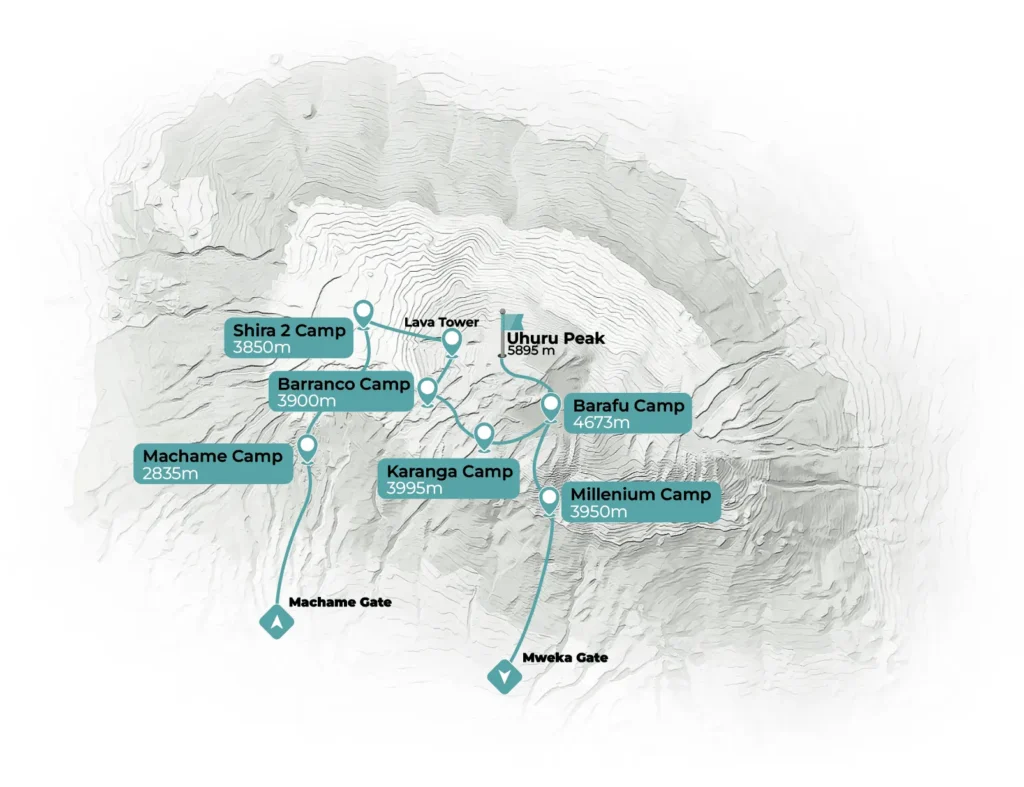
Machame is the route most experienced climbers choose, and for one reason: it’s hard enough to acclimatize you properly. The seven-day version adds a critical extra day above 12,000 feet, which is exactly the difference between hating your summit night and finishing it. The scenery is also the most varied — rainforest, moorland, alpine desert, glacier, all in one trip. If this is your one Kilimanjaro climb, this is the one to pick.
The Quiet Route
Lemosho is the route we recommend most often. It approaches the mountain from the quieter western side, gives you eight days instead of seven, and crosses the dramatic Shira Plateau before joining the southern circuit. You see more, you acclimatize better, and you pass fewer people on the trail. The extra day makes a real difference at altitude. If you have the time and the budget for one extra day, this is the smarter climb.

The Long Way
The Northern Circuit is the longest route on Kilimanjaro and the only one that truly circles the mountain. Nine days. Highest acclimatization profile of any route. The lowest number of climbers on the trail by a significant margin. Most of our Northern Circuit departures fill with returning clients and serious alpinists who want the full experience and the highest summit success odds the mountain offers. If you’ve climbed at altitude before, or if you simply want the version of Kilimanjaro fewer than 5% of climbers ever see, this is the route.

— THE PRICE QUESTION
US operators charge $5,500. We charge $2,400. Here's where the difference goes.
Where US operators spend $3,100 more
- US office, salaries, and overhead in dollars, not shillings
- Sales commissions to US-based agents and middlemen
- Brand marketing budgets that get billed back to climbers
- Subcontracting fees paid to local operators (often us)
What we don't pay for
- We're in Moshi. The team you book lives here, year-round
- We don't subcontract. There is no operator behind the operator
- We don't pay commissions. You email us. We reply in 12 hours
- Our marketing is climbers telling their friends
Same mountain. Same gear standards. Same oxygen, same medical protocols, same wages for porters. Different overhead.
— TRANSPARENT PRICING
Here's exactly what your money pays for.
INCLUDED IN EVERY CLIMB
- All park, conservation, camping, and rescue fees
- Professional mountain guides at a 1:2 guide-to-climber ratio
- Full porter team (carrying gear, tents, kitchen)
- All meals on the mountain — three hot meals daily, prepared by our mountain chef
- All tents, sleeping mats, mess tent, dining gear, and toilet tent
- Filtered drinking water throughout the climb
- Pulse oximeter monitoring twice daily, plus emergency oxygen on every trip
- Round-trip airport transfer from Kilimanjaro International (JRO)
- Two nights of hotel accommodation in Moshi (pre and post climb)
- Pre-climb equipment briefing and gear check
- Summit certificate
WHAT YOU'LL BUDGET SEPARATELY
- International flights to Kilimanjaro (JRO) — typically $1,200–$1,800 from US
- Tanzania visa — $100 for US passport holders, applied online
- Travel and medical insurance with high-altitude evacuation coverage (required)
- Personal climbing gear — full rental list available, $200–$300 if you rent everything
- Tips for guides, porters, and chef — recommended $300–$400 per climber
- Optional add-on: 3–7 day Tanzania safari or Zanzibar extension (we can quote)
— THE OPERATOR DIFFERENCE
If your itinerary is sold in dollars but your guides speak Swahili, somebody is making a margin you'll never see.
Kilimanjaro Brothers was founded by George Mtaki, who spent years working as a porter on this mountain before he started running climbs up it.
He built the company to do three things the international tour-operator economy usually doesn’t:
- Pay porters at or above fair-wage standards. Every climb. No exceptions.
- Brief guides on every climber individually before the trip. Not at the gate.
- Hire the mountain crew year-round, not per-trip. The team you book is the team that's been working together for years.
Your money stays in Tanzania.
Your climb is run by the people who built the company.
— YOUR CLIMB, DAY BY DAY
What climbing Kilimanjaro with us actually feels like.
People who’ve never done it picture either a pleasant hike or a near-death epic. Neither is right. Here’s the real shape of the experience.
01 — The first day will feel surprisingly easy.
You start in dense rainforest, the air is humid and warm, the trail is well-graded, and the altitude isn't yet a factor. This is by design. The mountain eases you in. Many climbers worry they're not pushing hard enough on day one. They are. The next five days do the work.
02 — Pole, pole.
Your guides will say this hundreds of times: pole, pole. Slowly, slowly. The Swahili instruction to walk at a deliberate, breathing-room pace is not a suggestion. It's the single most important variable in whether you summit. American climbers, especially fit ones, struggle with this more than anyone. Trust the pace.
03 — Eating becomes the hardest part.
Above 13,000 feet, your appetite vanishes. Our chef will still serve three hot meals a day and you'll need to eat them anyway — calories are how you make the summit. The chef adjusts portions and salt levels to altitude-affected appetites. Take this seriously. Climbers who don't eat don't summit.
04 — Summit night is its own thing.
You leave high camp around midnight. The next six hours are slow, cold, dark, and at the very edge of what you'll be willing to do. Then sunrise hits the glaciers and you remember why you came. The descent that follows is fast and tough on the knees. Most climbers cry at least once on summit morning. This is normal.
05 — You will not want to leave.
The last morning at the gate, you'll get your certificate, eat a real meal, and ride back to Moshi with a group of people who've become unexpectedly important to you. Most clients book a safari extension for the days after the climb. We can arrange that — just mention it in your enquiry.
— SAFETY & MEDICAL
Twice-daily health checks. Bottled oxygen on every climb. Evacuation plan before we leave the gate.
We don’t market on fear. But we do answer the safety question honestly because it’s the one question that should never be vague.
Daily medical monitoring
Every climber's pulse oximetry and resting heart rate are checked twice daily by the lead guide — morning and evening. Trends matter more than single readings. If a climber's numbers drift toward danger, we adjust the climb. We don't push.
Equipment we carry on every climb
- Bottled oxygen (2 cylinders minimum) — for emergencies, not summit boosters
- Portable Pulse Oximeters (4) for daily monitoring
- Comprehensive first aid kit — restocked before every departure
- Stretcher and emergency descent equipment at every camp
Guide certifications
Every lead guide is certified by the Kilimanjaro National Park (KINAPA), Wilderness First Responder (WFR) trained, and has 200+ summits of experience. Assistant guides are KINAPA-certified with 50+ summits.
Evacuation procedure
If a climber needs to descend urgently, an assistant guide and porter accompany them down by foot to the trailhead. From there: vehicle to AMREF or KCMC hospital in Moshi (60-90 minutes). For severe cases: helicopter evacuation coordinated through Kilimanjaro Search and Rescue (we’ll discuss insurance requirements in your briefing).
— WHAT HAPPENS IF
Honest answers to the questions you'd rather not ask.
You'll get your deposit refunded, minus a $200 administrative fee, if you cancel more than 60 days before departure. Inside 60 days, your deposit is non-refundable — but it's transferable. You can apply it to a future departure within 24 months, or transfer it to another climber.
If we cancel a scheduled departure for any reason — insufficient group size, weather, operational — you get a full refund within 7 days. No questions. No fine print. We have only cancelled three departures in 13 years; all three were refunded in full within a week.
If you have to descend before summiting — for altitude, illness, or any reason — you pay only for the days you climbed. We refund the remainder on a per-day basis within 14 days of the climb ending. Most operators don't do this. We think it's the only fair way.
Then we've failed at our job. Email us, tell us what we got wrong, and we'll refund any portion of the cost you think is fair.
— FROM RECENT CLIMBERS
Reviews from people who've actually done this.
Posted on TripadvisorVerified A great custom itinerary safari! This is my second safari I have booked through Kilimanjaro Brothers and it was great! I needed a custom itinerary because I was getting dropped off in Arusha and needed to be driven to Mwanza. George was super responsive with the itinerary and all the hotels and camps he picked were great! Our driver, Alfred, was simply the BEST! Such a cool guy, lots to share and fun too. My friend and I had a great time and I would absolutely book with them again. Safari njema!!Posted on TripadvisorVerified The best company on Kilimanjaro! When I finally reached what I had longed for, I never once forgot that it was all thanks to these amazing people. Thank you to the guides who made the journey fun, kind, and full of laughter — sometimes even teasing us in the best way. And to the best chef on Kilimanjaro — I could never have imagined having such delicious and abundant meals on the mountain. Honestly, even the toilet felt better than my bathroom back home, and the rented sleeping pad was as cozy as a real bed! Especially to the porters — none of this would have been possible without you. This journey was never just mine, it was truly ours. Thank you for giving me the best September of my life. I will never forget you, and I will miss you dearly. I can confidently say, this is the best company on Kilimanjaro!Posted on TripadvisorVerified Unforgettable 8-Day Kilimanjaro Adventure with a Spectacular Team! Amazing experience with Kilimanjaro Brothers! The team was spectacular, the food was excellent, and the guide Abel and others had great knowledge about the mountain and altitude. The 8-day Lemosho route was unforgettable!"Posted on TripadvisorVerified Incroyable, merci à toute l'équipe Kili brothers Nous avons fait confiance à Kilimandjaro Brothers pour notre ascension du Kilimandjaro. Une très belle expérience grâce à une équipe très professionnelle et aux petits soins pour nous. Eli et Paul ont été de très bons guides, avec d'excellentes connaissances de la montagne et très à l'écoute de nos envies et besoins. Un grand merci aux porteurs et au cuisinier pour ses excellents repas (Chakula kitamu). Nous n'avons manqué de rien durant l'ascension. Nous avons ensuite pris la route pour 5 jours de Safari avec Julian notre guide, un expert de la savane qui nous a permis de voir les Big 5 en seulement 3 jours. Kilimandjaro Brothers sont très flexibles concernant le planning, nous avons pu réaliser des days tours qui n'étaient prévu au planning initial, mais en Tanzanie tout est faisable et la communication est très simple. Hakuna Matata ! Petit coup de coeur pour la visite du village de Mto wa Mbu. Esau, notre guide nous a partagé les trésors de son village avec passion et authenticité. Je recommande vivement cette agence locale. Asante !Posted on TripadvisorVerified Would recommend Was a great trip! They helped put on a great show and made sure we were safe helping us reach the top of Kilimanjaro! Which was a great experience.Posted on TripadvisorVerified Excellent and Amazing 8-Day African Safari in Tanzania with Kilimanjaro Brothers, Eli Nassary and Decha Hamphrey Tanzania is an amazing and incredible country in Africa. We had the time of our lives, a dream come true! We fell in love with its people, the Tanzanians. They are very kind, made us feel at home and always saying “Hakuna matata”. We selected Kilimanjaro Brothers as our tour company for our 8-day safari and we were not disappointed. The private and personalized tour program was very well planned. Kilimanjaro Brothers assigned Eli Nassary and Decha Hamphrey as our support team. We were very fortunate to have Eli as our safari guide and driver. He made sure that we didn’t miss anything and he found ways to make our experience more memorable at the Serengeti, Tarangire and Lake Manyara National Parks and at the Ngorongoro Crater. We were able to see animals crossing the Mara river, as part of the great migration, just a few hours after we arrived at the Serengeti. This was partly made possible by Eli’s excellent communication with other tour guides because they all share information about animal sightings at the parks. When we were not able to visit one of the parks, Eli quickly found something interesting that we could do. We cannot miss to recognize that Eli has an eagle eye to see animals from afar. We didn’t see a kill but we learned it’s not that easy and patience is key to enjoy the wild life. Definitely, we want to comeback. Decha, on the hand, is a very talented photographer. With his state of the art camera, he captured our unforgettable memories of Africa with professionalism and high quality work. The photos and videos that we received are far better than the ones we took using our iPhones.Posted on TripadvisorVerified Trip of a lifetime, made better by this team of guides. What a trip! From being met at the airport, accompanied up the mountain and fed and watered, everything was organised well. George introduced the trip the evening before and then we were accompanied by the knowledgeable, cheerful and encouraging guides. A special shout out to Paulo, Rafael, Richard and Eli who ensured we were fully informed on the itinerary, had amazing food and kept us going at an appropriate pace. We beat the odds as a group, with 13/15 reaching the summit. I wouldn’t hesitate to recommend Kilimanjaro brothers. They have kit which can be borrowed, although we took our own.Posted on TripadvisorVerified Kilimanjaro Climb with Trekking Hero We had the pleasure of climbing Kilimanjaro on the Lemosho Route with our great guides Side (pronounced see Dee) and Martin from Trekking Hero. They did a masterful job in ensuring we climbed in a way to optimize acclimatization. The Trekking Hero team also did a great job in setting up camps, providing excellent meals and wonderful support. The one thing I’d recommend is to get the private toilet tents since the public tourist toilets are just holes in the cement floor, are typically filthy and doors to stalls don’t properly close.Posted on TripadvisorVerified BEST EXPERIENCE EVER! tldr: GO UP KILI WITH KILI BROTHERS I cannot say enough about the quality of my experience up Kilimanjaro with this company. I did the eight-day Lemosho route in November, and I had an absolutely phenomenal trek. Round-trip transportation was arranged for me from the airport to Moshi and back, and George, the owner of the company, was waiting for me at my hotel when I arrived. There are numerous things that makes Kili Brothers different from other companies. Kili Brothers is owned by brothers who used to be porters and are also guides themselves. With these personal experiences, they create fair labor conditions for all porters and guides. Additionally, they pay all employees fair wages. The mattresses and tents supplied are of high quality and cleanliness, as is the equipment available for rent. The food used for cooking is fresh and high-quality—during longer treks, a second team of porters will meet the cooks to replenish dwindling fresh food stocks, keeping hikers well-fed the entire journey. The porters are all incredibly kind and friendly, and they love chatting with the clients. The guides are incredibly well-trained and experienced, and they are phenomenal at sensing the needs of their clients throughout the entire journey. As a 21-year-old woman traveling in Africa by myself for the first time, safety was a paramount concern in finding my your company. The entire Kili Brothers team was cognizant of this fact and made sure I felt safe and secure at all times. Thank you to George, my guides Abel and Richard, and the entire Kili Brothers team for making my Kili summit a trip I will never forget!Posted on TripadvisorVerified Unforgettable Tanzanian Experience with Kilimanjaro Brothers! 8 days Lemosho & 5 days Safari exceeded expectations! Value for Money, Honest, Reliable, Superb Hospitality! Back in 2020, we liaised with George on both the hike expedition and safari tour. Finally travel resumed and we made the maiden trip this August 2022. Kilimanjaro brothers took care of everything from the minute we landed until the very last day. The hike was very well organised and we had the best crew of 12, ensuring our success to the peak - guided by Sanka and Arcardi. Camping equipments were sturdy, windproof and clean. They even provided us 4 inch thick mattress and we couldn’t be more comfortable in the mountain throughout the 8 days. The portable toilet was also sanitized and cleaned daily. Our chef, Willy and waiter, Ema totally rised up to the occasion and treated us with scrumptious meals daily. The cucumber soup was memorable. Honestly, we were mindblowned by the amount of nutritious food served. We wouldn’t have done it without the guidance of Sanka and Arcardi, who are both highly experienced. From pacing, clothes layering and ensuring we consume enough water – their mission was to get us to the roof of Africa safely. Highly recommended to always go with the locals as they know best! One dream, one team! Safari was one heck of an adventure and we couldn’t be happier and fortunate to have Elly Nassary as our safari guide. He kept us entertained throughout and shared with us stories about the animal kingdom. Very knowledgeable and a brilliantly skilled land cruiser driver. Of course, we were super lucky to catch the Great Migration of Serengeti with his amazing driving skills and awesome prediction. If you’re going for a safari adventure, ask for Elly Nassary! You won’t be disappointed! Feel free to request for a beer flight, throw in the list of animals you would want to tick off your bucketlist, go running after some wildebeest, check into the TZ/KY border – Elly is always up for challenge. Best Tanzanian experience we could have asked for! Thank you - Kilimanjaro Brothers, George, Sanka, Arcardi, Elly, Willy, Ema, and the whole team for making our trip such a memorable one! Asante sana and we couldn’t stop raving about the trip to our families, friends and everyone that we crossed path with!
— 2026 DEPARTURES
Pick a date. We'll hold a spot while you decide.
We run more than two departures per month from January through October. January–March and June–October are the prime climbing windows; April–May and November are wet seasons we don’t recommend.
| Dates | Price | Space | Book Now |
Full Moon Jun 4th 2026 – Jun 13 2026 | 8 | Join a Group $300 Deposit | |
Jun 14th 2026 – Jun 23 2026 | 8 | Join a Group $300 Deposit | |
| Jun 22, 2026 – Jul 1st 2026 | 8 | Join a Group $300 Deposit |
Dates | Price | Space | Book Now |
Jun 22 2026 – Jun 30 2026 | $2,200 | 8 | Join a Group $300 Deposit |
|
Dates |
Price |
Space |
Book Now |
|
Jul 2, 2026 – 9 Jul 2026 |
$2,000 |
8 |
Join a Group $300 Deposit |
|
Dates |
Price |
Space |
Book Now |
|
Aug 22, 2026 – Sep 2, 2026 |
$3,200 |
6 |
Join a Group $300 Deposit |
|
Dates |
Price |
Space |
Book Now |
|
Aug 2, 2026 – Aug 11, 2026 |
$2,500 |
8 |
|
|
Full Moon Aug 21, 2026 – Aug 30, 2026 |
$2,500 |
8 |
Join a Group $300 Deposit |
|
Dates |
Price |
Space |
Book Now |
|
Aug 22, 2026 – Aug 27, 2026 |
$2,500 |
6 |
Join a Group $300 Deposit |
|
Dates |
Price |
Space |
Book Now |
|
Sep 30, 2026 – Oct 4, 2026 |
$2,000 |
6 |
Join a Group $300 Deposit |
Dates | Price | Space | Book Now |
Full moon & Charity climb for cancer Oct 20, 2026 – Oct 28, 2026 | $2,500 | 8 |
Ready to lock in a 2026 climb?
Tell us which route and date. We’ll send the full briefing within 12 hours.
— THE PEOPLE ON THE MOUNTAIN
This is who you'll actually be climbing with.
Kilimanjaro Brothers is small enough that you’ll know our team by name within a day of landing in Moshi. Here’s who they are.

Plus a team of porters, assistant guides, and support staff — most of whom have been with us for over five years. We don’t subcontract. The people you meet on the mountain work for Kilimanjaro Brothers full-time. That’s what ‘locally owned and operated’ actually looks like.
Tell us which route.
We'll send your free 2026 briefing within 12 hours — straight from Moshi, no autoresponders.
- Real human reply within 24 hours, from Moshi
- No newsletter signup. No upsell calls. Just the briefing.
- If we can't help, we'll tell you who can.